
This article is about the on-stream death of French streamer Raphaël Graven. It covers what’s known (as best I could learn of Aug 20, 2025), the warnings that were ignored, and the wider culture that turns suffering into spectacle. Strong content ahead.
You can also watch my full breakdown and reflections on YouTube here:
On August 18, 2025, during a livestream marathon broadcast to thousands of viewers, French streamer Raphaël Graven — known online as Jean Pormanove, or simply “JP” — lay down on a mattress and never woke up. (Sky News Video)
At first, his younger co-streamers thought he was just sleeping. They laughed. They threw bottles. One even slapped him. Then the laughter stopped, and the stream cut out. Hours later, police confirmed what viewers already suspected: JP had died live, on camera, at the age of 46.
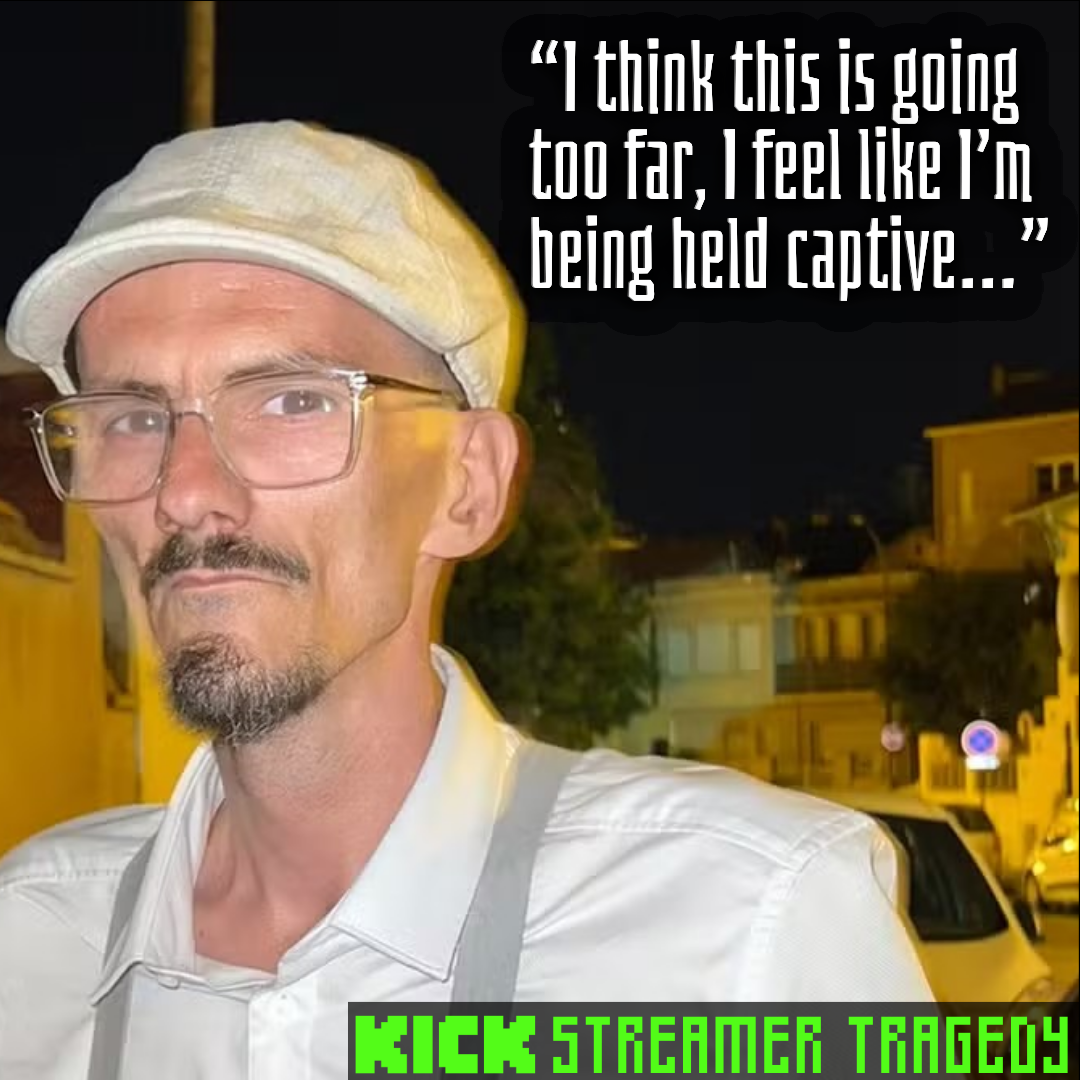
For months, thousands had tuned in to watch him be humiliated, slapped, and strangled for donations (Clip Here: CONTENT WARNING!). Clips show his so-called “friends” coercing him into saying that if he ever died, it would be from health issues, not their actions. One of his final texts to his mother was devastating: “I think this is going too far. I feel like I’m being held captive with their shitty concept. I’m fed up. I want to get out of here.”
His death was shocking. But it wasn’t random. It was the inevitable end of a slow-motion tragedy.
The Story of Jean Pormanove
Raphaël Graven wasn’t a teenager chasing clout. He was a middle-aged veteran trying to carve out meaning and connection in a digital world. Under the name Jean Pormanove, he built over a million followers across TikTok, Instagram, and Kick. His early streams were the usual gaming content—GTA V, FIFA, Fortnite—the same kind millions of creators pump out every day.
But his desire for belonging eventually led him into a group called Le LokalTV, a collective of younger streamers on Kick, the black sheep competitor to Twitch. Kick offered creators a massive 95% revenue share and looser moderation—freedom that attracted big names like Adin Ross, Drake and recently Mr Beast. But that looseness created space for abuse.
Within LokalTV, JP became the target. His role wasn’t really as a co-creator but as the spectacle. Difficult to watch clips show him slapped, strangled, mocked, shot with paintballs, and forced into degrading stunts while his younger co-hosts laughed. The ringleaders were Owen “Naruto” Cenazandotti, a streamer with a history of violence, and Safine Hamadi, just 23 years old. Together, they turned torturing a vulnerable middle-aged man into “content.”
And the audience played along. Viewers didn’t just watch; they paid. Donations poured in, often tied directly to humiliations and abuse. The cruelty wasn’t an accident of the stream — it was the business model.
By August 2025, the abuse escalated into a grotesque spectacle: a nonstop, 10-day livestream marathon from a rented house near Nice. On day ten, JP collapsed onto a mattress. The cameras kept rolling. Hours later, he was dead.
Police opened an investigation, prosecutors ordered an autopsy, and French Digital Minister Clara Chappaz called the whole ordeal “absolute horror.” Regulators were brought in. But the warnings had been ignored for months.
Back in December 2024, French media had already published exposés about Kick enabling abusive streams and even flagged JP by name. In January 2025, both Naruto and Safine were detained for “violence against a vulnerable adult” but were released when JP himself denied anything was wrong. The humiliation continued until it killed him.
A Wider Pattern
JP’s story isn’t an isolated tragedy.
Streaming has a history of turning abuse into entertainment. In Russia, streamer Stas Reeflay locked his girlfriend outside in sub-zero temperatures during a broadcast; she froze to death while viewers donated to keep it going. “IRL” prank channels have humiliated strangers in public, staged fake robberies, or pressured friends into dangerous stunts — all filmed without consent, all monetized in real time. Other cases have exposed sexual coercion on stream, with vulnerable women manipulated into degrading acts under the guise of “content.”
This is part of the larger, mentally and physically unhealthy culture that content creation has normalized — a culture where the boundaries of dignity, rest, and even safety are erased for the sake of views.
In 2017, Brian “Poshybrid” Vigneault, a 35-year-old father of three, collapsed during a 24-hour charity stream for Make-A-Wish. Doctors believed exhaustion and blood clots caused his death. In 2020, Twitch star Byron “Reckful” Bernstein died by suicide, crushed under the relentless pressures of public life and online harassment. Across Asia, reports continue to surface of gamers dying after multi-day binges in internet cafés. And in 2025, multiple marathon runners under 36 collapsed and died mid-race in Spain and Vietnam.
Whether physical or digital, pushing the human body past safe limits comes at a cost.
But JP’s case was darker. His death wasn’t just about exhaustion. It was about exploitation.
For the Audience: The Market for Suffering
This wouldn’t happen if there wasn’t a market for public pain. It’s the digital version of the circus freak show or the Roman coliseum. Thousands watch, and many pay, as people get humiliated, beaten, and degraded for their entertainment.
And it isn’t limited to extreme abuse. Streaming culture thrives on dares and humiliations: drink hot sauce, eat gross jellybeans, shock yourself on camera. Sometimes that’s fine—if it’s safe and the creator wants to do it. But sometimes they don’t. They feel like they have to. They think, “This is what streamers do. I have to do this to get more views.” And as audiences cheer, clip, or tip, it ony reinforces that belief and behaviour.
As I said on stream: “We look at them like they’re just dummies doing dumb stuff for laughs. But when normal people—who aren’t stunt guys or professionals—see that, they start mimicking it. And a lot of them are doing it out of desperation, out of loneliness, out of some hole in their heart they’re trying to fill.… People learn real quick that if they overshare, exploit themselves, or make themselves miserable on camera—people will watch. That drama becomes the content. It’s not because they want to, but because they feel like they have to.”
For Content Creators: Exploitation and Grind Culture
If you’re a content creator, JP’s death should stop you cold. Because what happened to him isn’t just about “some French streamer on Kick.” It’s about the dark side of the same culture you and I live in every day.
JP was exploited three ways at once:
- By collaborators who turned him into the butt of the joke.
- By audiences who literally paid to see him humiliated.
- By the grind itself — ten straight days of streaming until his body finally gave out.
That’s the extreme version. But the reason it should shake us is because it’s not as far from our world as we think.
Here’s the truth: every creator feels those same pressures, just dialed down. The algorithm tells you to never take a day off. Audiences push you to overshare your trauma, because pain keeps them watching. Parasocial relationships blur lines until you start performing your wounds instead of healing from them.
I said it bluntly on stream, and I’ll say it again:
“Some creators think if they take a day off, they’ll lose their audience forever. Others think their trauma is their only currency. That’s not content. That’s bondage.”
That’s the part nobody likes to talk about. We all know creators who build incentives that hurt themselves. “Five subs and I’ll chug hot sauce.” “Donations mean I’ll do the gross thing.” Sometimes it’s goofy and harmless — but not always. I’ve seen Christian creators build incentives around pain too, turning suffering into a gimmick. You have to stop and ask: why? Why am I doing this? Is this fun and life-giving — or am I just selling pieces of myself because I think that’s what’s expected?
JP didn’t die because of one prank, one dare, one bad stream. He died because exploitation and exhaustion became his brand. And if you’re not careful, the same culture will try to make that your brand too.
So let me talk to you directly as a fellow creator:
- Do you know your burnout warning signs?
- Do you have rules for yourself — lines you won’t cross even if the views tank?
- Are you letting your audience or the algorithm decide how much of your dignity you’re allowed to keep?
As I said on stream: “One of the undercurrents on Twitch is that people will share their deepest stuff because they know it’ll keep a community around. They’ll be extra vulnerable, talk about all kinds of struggles… and as good as that openness can be, it can also turn on them. Their trauma becomes their brand.”
I have a rule on my channel: I never show content that’s rooted in abuse, or mental illness, or someone exploiting themselves for attention. Could it get me more clicks if I did? Sure. But I refuse to be part of turning someone else’s suffering into entertainment.
The grind is real, the pressure is real, and the temptation to trade dignity for engagement is real. But you don’t have to let it make you as a content creator become the worst version of yourself.
3. For the Digital Church and the Watching World: Vulnerability and Exploitation
JP’s story is, at its heart, about loneliness. Here was a middle-aged man, a former soldier, who wanted friends so badly that he let men half his age humiliate him in front of thousands. He didn’t sign up to be a freak show attraction. He signed up because he wanted belonging.
That kind of vulnerability isn’t rare. It’s everywhere online. The lost, the lonely, the mentally ill, the disenfranchised — they gather in Twitch chats, Discord servers, TikTok comment sections. They’re looking for connection. And predators are waiting.
Sometimes exploitation is obvious: scams, manipulation, abuse broadcast live. But often it’s subtle. In my own community, I’ve seen it. One viewer was manipulated into giving away a chunk of his disability check to someone pretending to be a soldier in need. His compassion was exploited. Others have been pressured to overshare their trauma on stream because “it helps engagement.” I’ve seen ministries do this without realizing it: showering someone with love until it becomes conditional. Guilt-tripping people with lines like, “If you walk away, you’re not trusting God enough.” Monetizing compassion with donation alerts that reward someone’s pain.
As I said on stream: “Most victims don’t notice at first. They’re just so grateful someone is paying attention to them. But what looks like love can turn into control fast.”
This is why JP’s story matters for the digital church. Because if the church doesn’t show up, the only people who will are the ones who exploit. If we don’t create safe communities online, unsafe ones will thrive.
The lesson is simple but sobering: real community protects the vulnerable. Fake community exploits them. And everyone watching — whether you’re a Christian, a skeptic, or just curious about this space — needs to know that distinction.
Digital Missions: A Better Way Forward
JP’s death is devastating — but it doesn’t mean digital spaces are hopeless. It means they’re exactly where hope is needed most.
The people most at risk online — the lost, the lonely, the overlooked — are already here. They’re sitting in Twitch chats at 3am. They’re posting in Discord servers hoping someone will notice them. They’re pouring their hearts into TikTok comments because they don’t know where else to go. They’re not walking into a church building, but they’re still asking the same questions: Am I loved? Do I matter? Is there hope?
If the church doesn’t show up here, the only voices they’ll hear are the ones ready to exploit them.
That’s why I believe in digital missions. Not as a replacement for the church, but as an extension of it. Paul went to the synagogues, the marketplace, the Areopagus — the places where people gathered in his time. Today, the crowds gather online. That’s our mission field.
And that’s why TACO exists — The Alliance for Creative Outreach. We equip and support Christian creators who want to be missionaries in these spaces. Because predators, scammers, and exploiters are already here. But so are seekers. And if Christians are willing to step into these digital spaces with courage and compassion, they can become places of refuge instead of places of harm.
This isn’t just theory for me. I’ve seen it happen. People who felt abandoned by the church have found real community through a Twitch stream. Struggling young adults have discovered the gospel in a Discord Bible study. Lonely, hurting people have found love instead of exploitation in creator-led communities that put people first. That’s digital missions: meeting people where they are, not waiting for them to come to us.
It’s not easy. It requires boundaries. It requires discernment. It requires creators who are willing to put people over algorithms and compassion over clicks. But when it’s done well, it changes lives.
So here’s the question: what will you do with your corner of the internet? Will it become another stage for spectacle? Or can it become a place where the lost find love, the lonely find belonging, and the gospel meets people in their real lives?
That’s the better way forward. That’s why digital missions matters. That’s why TACO exists.
*This Article was Written With Assistance from ChatGPT 5